A market research firm says the global biopsy devices business is growing. Just not quickly.
Mordor Intelligence, in a press release issued October 13, 2026, estimates the market at USD 2.33 billion this year and projects it will reach USD 2.83 billion by 2031. That works out to a compound annual growth rate (CAGR), the smoothed yearly growth figure, of 3.97%.
Those are Mordor’s numbers, not settled fact. They also sit at the low end of what other research firms have published. For investors trying to size this corner of medtech, that gap says more than the headline does.
What Mordor Is Forecasting
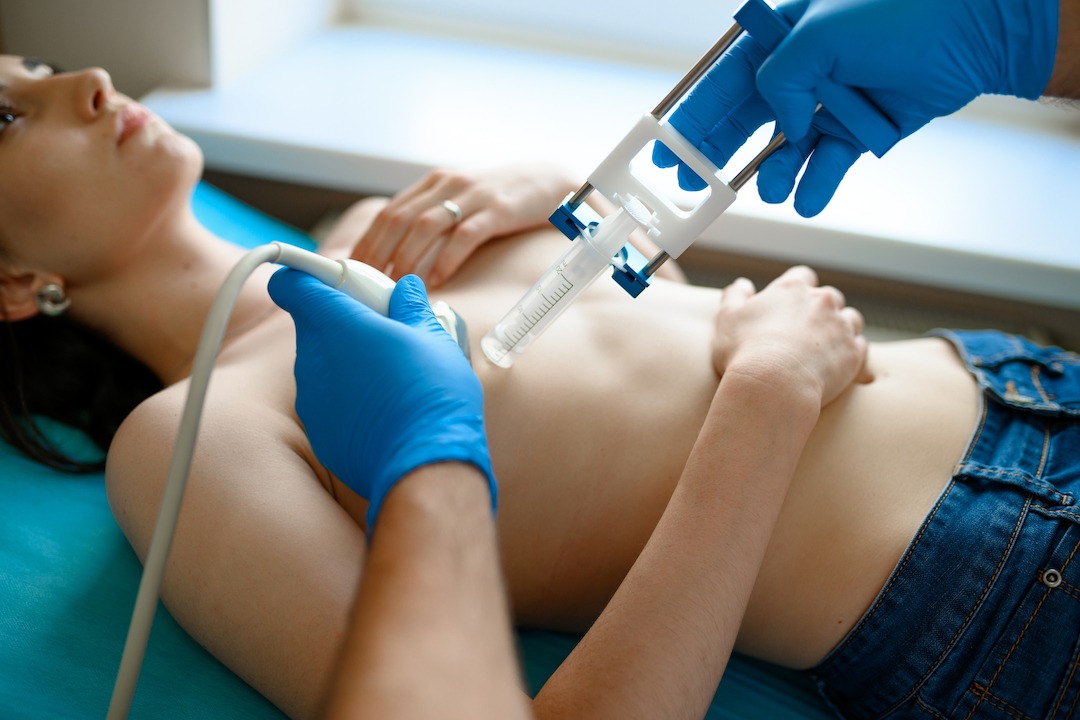
Biopsy devices are the needles, vacuum-assisted systems, procedure trays and localization wires clinicians use to take tissue from a suspicious lump or lesion. A pathologist then examines that tissue under a microscope. For most solid tumors, that is how a cancer diagnosis gets confirmed.
Mordor credits rising demand for early cancer diagnosis, broader use of image-guided procedures and better minimally invasive sampling tools. Image-guided means the doctor steers the needle using live ultrasound, CT or another scan. The firm also flags robotic navigation and AI-assisted imaging as opportunities, while conceding both depend on clinical validation and on whether hospitals can actually adopt them.
According to the release, North America holds the largest share and Asia-Pacific is a key growth region. Neither claim comes with a number attached.
The Estimates Don’t Agree
Slow down here. Market-size reports routinely clash, sometimes badly, because each firm draws the market’s boundaries differently and runs its own model.
Straits Research puts the market at USD 2.69 billion in 2026, growing 7.13% a year through 2034. Global Market Insights valued it at USD 2.9 billion back in 2024, with 6% annual growth ahead. IMARC Group had it at USD 2.8 billion in 2024, growing 5.47% a year. DelveInsight is the outlier, at about USD 5.8 billion for 2024 and an 8.09% CAGR.
Mordor’s 2026 starting point is below several rivals’ 2024 figures. Its growth rate is the slowest of the bunch.
None of these numbers are audited. Mordor’s release doesn’t describe its methodology, and the full report is sold separately. Which estimate is right? Nobody outside these firms can say. What they share is direction: every forecast cited here projects growth.
Who Actually Makes These Devices
The release names five “major companies”: Argon Medical Devices, Cook Medical, Hologic, Becton, Dickinson and Company (BD) and Boston Scientific. It lists no tickers and no market shares.
Only two trade as standalone public stocks. BD is listed on the New York Stock Exchange as BDX. Boston Scientific trades there as BSX.
For both, biopsy is a sideline. BD reported about USD 4.7 billion in revenue for its fiscal second quarter of 2026. Boston Scientific posted USD 5.2 billion in first-quarter 2026 sales. By simple comparison, all but one of the estimates above size the entire global biopsy device market at less than a single quarter of either company’s revenue.
The other three are a different story. Hologic, a long-standing name in breast biopsy, was taken private in April 2026 by funds managed by Blackstone and TPG, in a deal valued at up to USD 18.3 billion. Its shares no longer trade on Nasdaq. Part of the payout came as a contingent value right (CVR), worth up to USD 3 per share, which pays only if Hologic’s Breast Health business hits certain revenue goals in fiscal 2026 and 2027.
Cook Medical has been family-held and private since its founding. Argon, based in Plano, Texas, agreed in 2017 to be acquired by China’s Shandong Weigao Group Medical Polymer for USD 850 million. Weigao trades in Hong Kong (HKEX: 1066), so public-market exposure to Argon runs only through a much larger parent.
The Demand Underneath
The driver is simple. More screening turns up more suspicious findings, and many of them need tissue to confirm or rule out cancer.
The American Cancer Society projects roughly 2.11 million new cancer cases in the U.S. in 2026. Four of Mordor’s application segments line up with some of the most common: an estimated 333,830 prostate cancer cases, 321,910 female breast cancer cases, about 229,410 lung cancer cases and 158,850 colorectal cases.
Those aren’t biopsy counts. Plenty of biopsies come back benign, and some patients need more than one. Still, they give a sense of the volume feeding this market.
What the Release Leaves Out
A lot. There’s no methodology, no segment-level sizing and no regional dollar figures. No company market shares, either. The only quote, from Mordor senior research manager Soumya Goud, describes Mordor’s own research approach rather than the market.
Pricing and reimbursement go unmentioned. So does any evidence on how AI or robotic systems are performing in biopsy today.
One more thing. The same release promotes a related Mordor report on solid tumor testing that cites expanding liquid biopsy applications. Blood-based testing is its own growth story. Whether it eventually takes work away from needles, the biopsy release doesn’t say.
The Takeaway
This is a backdrop story, not a catalyst. Depending on the firm, the market is somewhere between roughly USD 2.3 billion and USD 5.8 billion, growing between about 4% and 8% a year. Either way, it is small next to the overall businesses of BD or Boston Scientific.
And the best-known breast biopsy name on Mordor’s list, Hologic, is no longer on a public exchange.
The forecasts agree on direction. On speed, it depends on whose report you read.
Sources
- Mordor Intelligence: Biopsy Devices Market to Reach USD 2.83 Billion by 2031 Driven by Minimally Invasive Diagnostics and Image-Guided Procedures, PRNewswire, October 13, 2026. Primary source release.
- Straits Research: Biopsy Devices Market Size & Share Analysis, cited for a competing 2026 market-size estimate and growth rate.
- Global Market Insights: Biopsy Devices Market Size & Share 2025-2034, cited for a competing 2024 market-size estimate and growth rate.
- IMARC Group: Biopsy Devices Market Report, cited for a competing 2024 market-size estimate and growth rate.
- DelveInsight: Biopsy Devices Market Insights, Competitive Landscape and Market Forecast 2032, cited for the highest competing market-size estimate reviewed.
- Hologic: Blackstone and TPG Complete Acquisition of Hologic (Form 8-K, Exhibit 99.1, SEC EDGAR), cited for completion of the take-private deal, Nasdaq delisting and contingent value right terms.
- MedTech Dive: Hologic to Be Acquired by Blackstone, TPG in Deal Valued at Up to $18.3 Billion, cited for the deal value and Breast Health revenue conditions on the contingent value right.
- Benzinga: Hologic Goes Private in $18 Billion Blackstone, TPG Acquisition, cited for the April 2026 closing date.
- MassDevice: Shandong Weigao to Pay $850m for Argon Medical Devices, cited for Argon’s ownership, headquarters and acquisition price, none of which appeared in the release.
- Cook Medical Newsroom, cited for Cook Medical’s status as a family-held private corporation.
- BD Investor Relations, cited for BD’s NYSE listing and fiscal Q2 2026 revenue.
- Nasdaq/RTTNews: Boston Scientific Lowers FY26 Guidance, cited for Boston Scientific’s NYSE listing and Q1 2026 net sales.
- American Cancer Society: Estimated Number of New Cases for the Four Major Cancers, 2026, cited for 2026 U.S. cancer incidence estimates.
Editorial Disclosure
This article reports on a market research forecast issued by Mordor Intelligence Private Limited on October 13, 2026, regarding the global biopsy devices market. Securities and corporate structures discussed: Becton, Dickinson and Company (NYSE: BDX), Boston Scientific Corporation (NYSE: BSX), and Shandong Weigao Group Medical Polymer Co., Ltd. (Hong Kong Stock Exchange: 1066, parent of Argon Medical Devices). Hologic, Inc. and Cook Medical are privately held and not publicly traded. Company ownership, ticker, deal, and revenue details, competing market-size estimates, and U.S. cancer incidence figures were drawn from the independent sources cited above, since the original release did not address them. BioTech Stocks Daily has not received, nor will it accept, any compensation, direct or indirect, from Mordor Intelligence, any company named in this article, or any other corporate or third-party sponsor for the preparation or publication of this coverage. No staff member, principal, or affiliate of BioTech Stocks Daily holds a position, option, or financial interest in any of the securities mentioned as of the date of publication. Statements regarding projected market size, growth rates, regional demand, technology adoption, and contingent payments tied to future revenue goals are forward-looking statements. They involve substantial risks and uncertainties; actual results may differ materially. Market-size figures are produced by commercial research firms using proprietary methodologies that are not publicly disclosed and should not be treated as objective fact. Medical device investments carry financial risk, including competitive, pricing, regulatory, and reimbursement pressures, which can result in the loss of invested capital. This article is published strictly for independent news reporting, market context, and educational purposes only. It does not constitute an investment recommendation, endorsement, or professional financial, legal, or tax advice. Furthermore, this content is not medical advice; patients and healthcare providers should consult appropriate clinical professionals for medical guidance.
For full details regarding our editorial independence, publishing policies, and comprehensive risk disclaimers, please see our full Terms & Disclaimers Page